

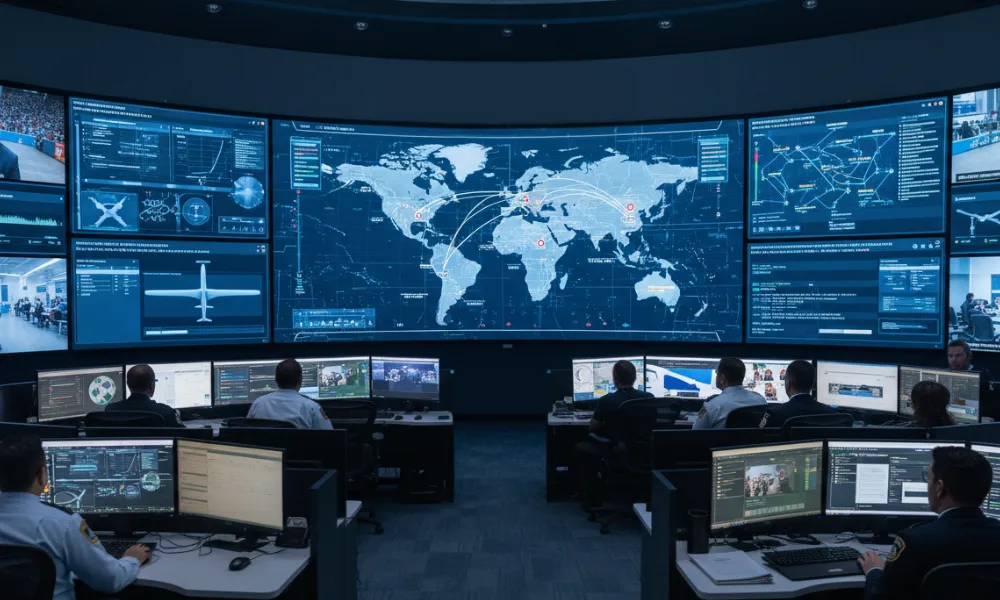
Hosting 48 teams, 104 matches, across three countries and sixteen host cities, FIFA World Cup 2026 is set to become the largest sporting tournament ever staged. The scale of the event brings enormous logistical opportunities, but it also creates security challenges that governments have been planning for years in advance.

FIFA World Cup 2026 security threats include terrorism, cyberattacks targeting event infrastructure, and large-crowd safety risks, according to publicly available assessments from security agencies and international intelligence partners. The United States, Canada, and Mexico have already established coordinated multi-agency security frameworks to prepare for these threats.
This article focuses exclusively on publicly available intelligence assessments, government briefings, official statements, and security planning documents rather than speculation or rumor. You’ll find a factual breakdown of the risks security agencies have publicly identified, the measures being implemented across the tournament, and what those developments actually mean for fans traveling to World Cup 2026 matches.
| Book Hotels Near FIFA WC ’26 Stadiums |
|---|
Table of Content
- Security Overview Table of FIFA World Cup 2026
- What Intelligence Agencies Have Publicly Said about FIFA World Cup 2026
- Terrorism and Extremism- The Highest-Profile Threat Category for FIFA World Cup 2026
- Cyber Threats- The Invisible Security Risk Fans Don't Think About
- Crowd Safety- The Under-Reported Threat Category
- Security Arrangement for Mexico City during FIFA World Cup 2026
- What FIFA and Host Governments Are Doing- The Full Security Response
- Practical Safety Guidance for The Fans Visiting for FIFA World Cup 2026
- Conclusion
- More Related Blogs From Tips & Tricks
Security Overview Table of FIFA World Cup 2026
Terrorism / Extremism
Cyberattacks on Infrastructure
Crowd Crush / Mass Casualty Incidents
Criminal Activity / Petty Crime
Civil Unrest
Foreign State Interference
Public Health Emergencies
Mexico City-Specific Risks
Key-note: Risk level does not mean danger is inevitable. It reflects the planning assumptions and preparedness priorities security agencies are working from, not a prediction of what will happen during the tournament.
What Intelligence Agencies Have Publicly Said about FIFA World Cup 2026
Security discussions surrounding FIFA World Cup 2026 often generate headlines, but the most useful information comes directly from official statements, government planning documents, and publicly disclosed security frameworks. This section focuses exclusively on what agencies have publicly communicated rather than speculation, anonymous leaks, or unverified reporting.
FBI, DHS, and Interpol- The Official Public Record about FIFA World Cup 2026
Publicly available information shows that security agencies across North America have been preparing for World Cup 2026 for years. The scale of the tournament, spanning three countries and sixteen host cities, requires coordination rarely seen outside major international summits and Olympic Games.
The FBI has confirmed preparations for World Cup security operations, drawing on experience gained from securing Super Bowls, international sporting events, and other large-scale gatherings across the United States. Dedicated planning teams have been established to coordinate intelligence, venue security, and threat monitoring.
The Department of Homeland Security (DHS) has repeatedly identified major international sporting events as elevated-risk environments that require extensive cooperation between federal, state, local, and international partners. Its public preparedness frameworks emphasize crowd safety, infrastructure protection, emergency response, and information sharing.
Interpol has also confirmed cross-border coordination efforts involving the United States, Canada, and Mexico. These frameworks build on international cooperation models used at previous tournaments and focus on intelligence sharing, criminal investigations, and real-time threat assessment across multiple jurisdictions.
Meanwhile, the Cybersecurity and Infrastructure Security Agency (CISA) has identified World Cup 2026 as a critical infrastructure protection priority. Public planning documents highlight concerns around ticketing systems, transportation networks, communications infrastructure, and broadcast operations.
One important point often overlooked is that intelligence assessments are a routine part of planning for events of this magnitude. Their existence signals preparation and risk management, not an expectation that a major incident will occur. Similar security frameworks were implemented before the 2014, 2018, and 2022 FIFA World Cups, all of which concluded without a major tournament-wide security event.
Terrorism and Extremism- The Highest-Profile Threat Category for FIFA World Cup 2026
Among all publicly discussed security concerns surrounding FIFA World Cup 2026, terrorism and violent extremism receive the highest level of attention from intelligence and law enforcement agencies.
That focus is largely driven by the tournament’s scale, global visibility, and the concentration of large crowds across multiple host cities. Understanding why security planners prioritize this threat category helps put many of the event’s protective measures into context.

Why World Cup 2026 Is Considered a High-Value Target by Security Analysts
Large international sporting events have long been treated as attractive targets by security agencies because they combine global media attention, symbolic significance, and concentrated crowds in a limited area. The concern is not that an incident is expected, but that the potential consequences of any disruption are unusually high.
Modern event security planning is heavily shaped by historical precedents. The 1972 Munich Olympics remains one of the most influential case studies in international event security. The 1996 Atlanta Olympics bombing demonstrated that major sporting events on US soil can face domestic security threats. More recently, the 2013 Boston Marathon bombing reinforced the need for layered security measures around public gatherings and transportation corridors.
Several factors make World Cup 2026 particularly complex from a security perspective. The tournament spans three countries, creating significantly more border crossings and intergovernmental coordination requirements than previous editions. Security planners must also manage 16 host cities simultaneously, each with its own stadiums, fan zones, transport networks, and emergency response systems.
To address these challenges, authorities have publicly outlined a range of mitigation measures. These include enhanced stadium perimeter security, temporary no-fly restrictions over match venues, intelligence-sharing agreements with international partners, and increased deployment of uniformed and plainclothes personnel across venues, fan areas, airports, and major transit hubs.
The existence of these measures reflects the scale of the event and the level of preparation involved. Security agencies routinely plan for worst-case scenarios so that fans can focus on the tournament itself.
Cyber Threats- The Invisible Security Risk Fans Don't Think About
While physical security receives most of the public attention, cybersecurity has become one of the highest-priority planning areas for major sporting events. A successful cyberattack can disrupt ticketing systems, transportation networks, stadium operations, and fan communications without ever affecting the venue itself.
For supporters traveling across multiple cities and relying heavily on digital platforms, cyber incidents can create real-world problems long before kick-off.
World Cup 2026 Cyberattacks: What CISA and FIFA Are Preparing For?
Cybersecurity concerns surrounding FIFA World Cup 2026 extend far beyond IT departments. Ticketing system breaches could lead to counterfeit tickets entering circulation or legitimate tickets becoming inaccessible.
Disruptions to transport applications or stadium access systems could create delays for thousands of fans on match day. Security experts also continue to warn about phishing campaigns, fake tournament websites, and fraudulent communications designed to steal personal information and payment details.
Large sporting events have faced cyber threats before. During the 2018 FIFA World Cup in Russia, malware linked to the “Olympic Destroyer” family reportedly targeted event-related systems. The Tokyo Olympics in 2021 reportedly recorded hundreds of millions of attempted cyberattacks during the event period. Ahead of Super Bowl LVI, US authorities publicly warned fans about credential theft and fake ticketing websites.
In response, authorities have elevated cybersecurity planning for World Cup 2026. Critical tournament infrastructure has been designated for enhanced protection, while FIFA’s cybersecurity teams are conducting penetration testing, vulnerability assessments, and simulated attack exercises before the tournament begins.
For fans, basic cyber hygiene remains one of the strongest defenses:
- Purchase tickets only through official FIFA channels.
- Use a dedicated travel email address for tournament bookings.
- Enable two-factor authentication on all tournament-related accounts.
- Avoid unsecured public Wi-Fi when accessing sensitive information.
- Verify emails, messages, and payment requests through official channels before clicking links or sharing details.
Crowd Safety- The Under-Reported Threat Category
Security discussions around major sporting events often focus on terrorism and cyber threats, yet crowd management remains one of the most significant operational challenges. Large gatherings can become dangerous even without criminal intent when crowd density, movement patterns, and emergency access routes are not properly managed.
For a tournament expected to attract millions of spectators across multiple countries, crowd safety is treated as a core security priority rather than a simple venue operations issue.
Mass Gathering Safety Risks at the World Cup 2026's Mega-Venues
Crowd safety has become a major focus area within modern event security planning. Agencies responsible for public safety increasingly classify crowd-related incidents as a distinct risk category because they can escalate rapidly and affect large numbers of people within minutes.
Recent events have highlighted these dangers. The Astroworld festival tragedy in 2021 and the Seoul Halloween crowd crush in 2022 demonstrated how crowd density, restricted movement, and limited escape routes can create life-threatening conditions even without a deliberate attack.
World Cup 2026 presents several crowd-management challenges. Large venues such as MetLife Stadium will host tens of thousands of spectators, while fan zones in major cities may attract crowds ranging from 50,000 to 100,000 people. Simultaneous matches across multiple locations also place additional demands on emergency response coordination.
To address these risks, authorities are conducting extensive preparedness exercises. Emergency management agencies are running mass-gathering response drills, FIFA is implementing crowd-flow monitoring systems, and host-city emergency services are rehearsing venue-specific evacuation procedures.
One simple precaution can make a meaningful difference: identify the nearest emergency exit as soon as you arrive at a stadium or fan zone, rather than waiting until an incident occurs.
Security Arrangement for Mexico City during FIFA World Cup 2026
Among all World Cup 2026 host cities, Mexico City receives the most security-related questions from international fans. Much of that attention comes from travel advisories, media coverage, and general perceptions about crime in Mexico.
The reality is more nuanced. Security agencies do identify specific risks, but they also distinguish clearly between areas of concern and the districts where most visitors, hotels, and tournament activities are concentrated.
What the US State Department Advisory Actually Means for World Cup Fans
Mexico City is currently subject to a Level 2 “Exercise Increased Caution” travel advisory from the US State Department. Importantly, this is not a recommendation to avoid travel. The same advisory level applies to several major destinations across Europe and reflects a need for awareness rather than alarm.
The advisory primarily highlights risks such as pickpocketing, opportunistic theft in crowded areas, and the possibility of express kidnapping in certain parts of the city. It also references criminal activity linked to organized groups, though these concerns are generally concentrated in specific neighborhoods that are separate from major tourist zones and World Cup infrastructure.
For visiting fans, practical precautions remain straightforward. Use ride-hailing services instead of unlicensed street taxis, stay within established tourist and entertainment districts, and avoid traveling alone late at night when possible.
Areas surrounding major event infrastructure have hosted international sporting events for decades, and security presence during the tournament is expected to be significantly increased through coordinated federal, state, and local operations.
What FIFA and Host Governments Are Doing- The Full Security Response
Security planning for FIFA World Cup 2026 is not centered on a single agency or country. The tournament spans three nations, 16 host cities, and more than a month of competition, requiring an integrated security model that combines intelligence, law enforcement, emergency management, transportation authorities, and private-sector partners.
While public attention often focuses on potential threats, the scale of the preparation effort is equally significant. The measures already announced provide insight into how host governments are approaching one of the largest security operations ever attached to a sporting event.
The Multi-Layered Security Framework Behind FIFA World Cup 2026
- Joint Operations Centers: The USA, Canada, and Mexico are establishing unified command centers designed for real-time information sharing and cross-border threat coordination.
- Venue Security Perimeters: All stadiums and official fan zones will operate with layered security zones, vehicle exclusion areas, controlled access points, and enhanced credential verification systems.
- Air Security: Temporary flight restrictions are expected over venues during match periods, with military and aviation security assets available to support airspace protection.
- Intelligence Sharing: Formal intelligence-sharing arrangements between the three host nations and allied security partners will support rapid threat assessment and response.
- Private Security Support: Government agencies will be supplemented by private security contractors responsible for venue screening, crowd management, and operational support.
Current projections indicate that the overall security investment for World Cup 2026 could surpass any previous FIFA tournament, reflecting both the event’s scale and the complexity of operating across three countries simultaneously.
Practical Safety Guidance for The Fans Visiting for FIFA World Cup 2026
Security planning happens at the government and agency level, but individual preparation still matters. Public intelligence assessments consistently show that the biggest risks faced by most attendees are not dramatic incidents, but preventable issues such as lost documents, scams, transportation disruptions, and poor situational awareness. A few simple precautions can significantly reduce exposure to these risks and make responding to unexpected situations much easier.
Best Approach to Stay Safe at FIFA World Cup 2026:
- Register your trip with your country’s foreign travel advisory service so authorities can contact you during emergencies or major disruptions.
- Keep both digital and physical copies of passports, visas, tickets, and insurance documents in separate locations.
- Share your match-day plans with a trusted contact at home, including accommodation details and travel routes.
- Know the location and contact details of your nearest embassy or consulate in every host city you visit.
- Save local emergency numbers before arrival: 911 in the USA, 911 in Canada, and 911 in Mexico.
- Follow venue security instructions immediately if an evacuation, delay, or movement restriction is announced.
- Purchase travel insurance that includes emergency medical and evacuation coverage, particularly if attending matches in Mexico City.
- Avoid large unofficial gatherings outside designated fan zones, where crowd management and security oversight may be limited.
These recommendations are not responses to any specific threat. They are standard risk-reduction measures used by experienced travelers, security professionals, and major event organizers worldwide.
Conclusion
Security threats surrounding FIFA World Cup 2026 are neither hypothetical nor unique. Every major international sporting event attracts heightened attention from intelligence agencies, law enforcement, and cybersecurity teams. What makes this tournament different is its scale: 48 teams, 104 matches, three host countries, and millions of traveling fans.
Publicly available assessments show that authorities are treating terrorism, cyber threats, crowd safety, and criminal activity as serious planning priorities, backed by one of the most extensive security operations ever assembled for a FIFA tournament. For fans, awareness matters more than anxiety.
Understanding the risks, following official guidance, and preparing in advance can significantly reduce exposure to common problems.Before finalizing your trip, explore our companion guides on travel insurance and accommodation planning, and bookmark official government travel advisories for the latest updates throughout the tournament.
More Related Blogs From Tips & Tricks




Margaret C. Jones
Margaret C. Jones, a passionate explorer of North America, captivates readers with her vivid tales on Travelarii’s blog. With a keen eye for hidden gems and local culture, Margaret offers expert advice and unique insights to enhance your travel experience. Her stories bring the diverse landscapes and vibrant cities of North America to life, inspiring readers to embark on their own adventures.